Tuesday, May 3, 2011


Tuesday, November 2, 2010


Thursday, February 18, 2010
Andaman and Nicobar Islands : Land, People, History, Flora & Fauna
The 572 islands territory, Andaman and Nicobar Islands, of which only 36 are permanently inhabited. The territory comprises of two island groups, the Andamans and Nicobars are separated by a channel (the Ten Degree Channel) some 150 km wide. Most of the islands (about 550) are in the Andamans group, the smaller Nicobars comprise some 22 main islands. The total area of the Andaman Islands is some 6,408 km2 that of the Nicobar Islands approximately 1,841 km2.

History
The Andaman and Nicobar islands have been inhabited for several thousand years. The earliest archaeological evidence dates back to some 2,200 years. Natives maintained their separated existence through the vast majority of this time, diversifying into distinct linguistic, cultural and territorial groups. It was by the 1850s when they first came into sustained contact by outside groups.
The indigenous people of the Andamans were:
the Great Andamanese, who collectively represented at least 10 distinct sub-groups
As the numbers of settlers from the mainland increased (at first mostly prisoners and involuntary indentured labourers, later purposely recruited farmers), these indigenous people lost territory and numbers in the face of punitive expeditions by British troops, land encroachment and the effects of various epidemic diseases. The Jangil and most of the Great Andamanese groups soon became extinct; presently there remain only approximately 400–450 indigenous Andamanese, the Jarawa and Sentinelese in particular maintaining a steadfast independence and refusing most attempts at contact.
The indigenous people of the Nicobars (unrelated to the Andamanese) have a similarly isolated and lengthy association with the islands.
There are two main groups:
the Nicobarese, or Nicobari, living throughout many of the islands; and
the Shompen, restricted to the interior of Great Nicobar.

FLORA AND FAUNA
These Islands are blessed with a unique' luxuriant evergreen tropical rainforest canopy, sheltering a mixed germ plams bank, comprising of Indian, Myanmarese, Malaysian and endemic floral strain. So far, about 2200,varieties of plants have been recorded out of which 200 are endemic and 1300 do not occur in mainland India.
"The South Andaman forests have a profuse growth of epiphytic vegetation, mostly ferns and orchids. The Middle Andamans harbours mostly moist deciduous forests. North Andamans is characterised by the wet evergreen type, with plenty of woody climbers. The north Nicobar Islands (including Car Nicobar and Battimalv) are marked by the complete absence of evergreen forests, while such forests form the dominant vegetation in the central and southern islands of the Nicobar group. Grasslands occur only in the Nicobars, and while deciduous forests are common in the Andamans, they are almost absent in the Nicobars". The present forest coverage is claimed to be 86.2% of the total land area. Andaman Forest is abound in plethora of timber species numbering 200 or more, out of which about 30 varieties are considered to be commercial. The Holy Rudraksha (Elaeocarps sphaericus) and aromatic Dhoop/Resin trees also occur here.
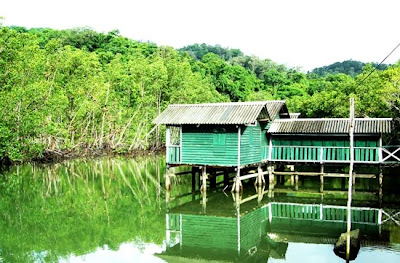
This tropical rain forest despite its isolation from adjacent land masses is surprisingly enriched with many animals. About 50 varieties of forest MAMMALS are found to occur in A&N Islands, most of them are understood to be brought in from outside and are now considered endemic due to their prolonged insular adaptation. With about 225 species, the A&N Islands house some of the larger and most spectacular butterflies of the world. Ten species are endemic to these Islands. These islands are traditionally known for their shell wealth specially Turbo, Trochus, Murex and Nautilus. Andaman Wood Pigeon (STATE BIRD) is an endemic bird, which is found only in Andaman and Nicobar group of islands. Dugong, an endangered marine mammal, also known as Sea Cow, (STATE ANIMAL). Dugong is distributed in shallow tropical waters in Indo-Pacific Region. Within A&N Islands Dugong has been reported from Ritchie”s Archipelago, North Reef, Little Andaman and parts of Nicobars. Andaman Padauk (STATE TREE) is a tall deciduous tree found only in Andaman.

History
The Andaman and Nicobar islands have been inhabited for several thousand years. The earliest archaeological evidence dates back to some 2,200 years. Natives maintained their separated existence through the vast majority of this time, diversifying into distinct linguistic, cultural and territorial groups. It was by the 1850s when they first came into sustained contact by outside groups.
The indigenous people of the Andamans were:
the Great Andamanese, who collectively represented at least 10 distinct sub-groups
and languages;
the Jarawa;
the Jangil (or Rutland Jarawa);
the Onge; and Sentinelese (most isolated of all the groups).
As the numbers of settlers from the mainland increased (at first mostly prisoners and involuntary indentured labourers, later purposely recruited farmers), these indigenous people lost territory and numbers in the face of punitive expeditions by British troops, land encroachment and the effects of various epidemic diseases. The Jangil and most of the Great Andamanese groups soon became extinct; presently there remain only approximately 400–450 indigenous Andamanese, the Jarawa and Sentinelese in particular maintaining a steadfast independence and refusing most attempts at contact.
The indigenous people of the Nicobars (unrelated to the Andamanese) have a similarly isolated and lengthy association with the islands.
There are two main groups:
the Nicobarese, or Nicobari, living throughout many of the islands; and
the Shompen, restricted to the interior of Great Nicobar.

FLORA AND FAUNA
These Islands are blessed with a unique' luxuriant evergreen tropical rainforest canopy, sheltering a mixed germ plams bank, comprising of Indian, Myanmarese, Malaysian and endemic floral strain. So far, about 2200,varieties of plants have been recorded out of which 200 are endemic and 1300 do not occur in mainland India.
"The South Andaman forests have a profuse growth of epiphytic vegetation, mostly ferns and orchids. The Middle Andamans harbours mostly moist deciduous forests. North Andamans is characterised by the wet evergreen type, with plenty of woody climbers. The north Nicobar Islands (including Car Nicobar and Battimalv) are marked by the complete absence of evergreen forests, while such forests form the dominant vegetation in the central and southern islands of the Nicobar group. Grasslands occur only in the Nicobars, and while deciduous forests are common in the Andamans, they are almost absent in the Nicobars". The present forest coverage is claimed to be 86.2% of the total land area. Andaman Forest is abound in plethora of timber species numbering 200 or more, out of which about 30 varieties are considered to be commercial. The Holy Rudraksha (Elaeocarps sphaericus) and aromatic Dhoop/Resin trees also occur here.

This tropical rain forest despite its isolation from adjacent land masses is surprisingly enriched with many animals. About 50 varieties of forest MAMMALS are found to occur in A&N Islands, most of them are understood to be brought in from outside and are now considered endemic due to their prolonged insular adaptation. With about 225 species, the A&N Islands house some of the larger and most spectacular butterflies of the world. Ten species are endemic to these Islands. These islands are traditionally known for their shell wealth specially Turbo, Trochus, Murex and Nautilus. Andaman Wood Pigeon (STATE BIRD) is an endemic bird, which is found only in Andaman and Nicobar group of islands. Dugong, an endangered marine mammal, also known as Sea Cow, (STATE ANIMAL). Dugong is distributed in shallow tropical waters in Indo-Pacific Region. Within A&N Islands Dugong has been reported from Ritchie”s Archipelago, North Reef, Little Andaman and parts of Nicobars. Andaman Padauk (STATE TREE) is a tall deciduous tree found only in Andaman.
Thursday, January 21, 2010
Discover Diglipur, North & Middle Andaman Islands

The beautiful islands of Andamans have always been on my list of the most beautiful places I have ever seen. This was my second visit to andamans organised by prasad when I went to far north of the islands, in to less frequented Diglipur region which houses some of the most beautiful locations like the saddle peak, smith and ross islands and many others in its vicinity.


We also had the opportunity to explore some of the undiscovered and very old caves near diglipur. The experience was very adventurous and memorable. I still can remember those beautiful wild caves full of bats and the darkness which we had to fend.The hawabill birds nest in these caves and we were able to spot some of the nests in their early stages.The trek to these caves was tough but well guided.


Our next day was spent with the breathtaking beauty of the ross and smith islands.These two green islands are connected with about 500meter long sand strip. Picturesque and pure. Blue sea and white isolated beaches are common in andamans and nicobar islands,but ross and smith are exceptional .Standing at the sand strip, one can see blue waters on both sides and far off diglipur with the peaks in the skyline making it a sight to behold.


Back at our beach resort in diglipur, I was amazed at the star lit sky at the beach where we went with our torchlights off to search for olive redly turtles which nest there.Appropriate definition of solitude and being one with nature.. The sound of waves coupled with the star sprinkled sky and rustling wind.Out of the world experience.


Overall one of the most beautiful experiences of my life.It would not have been possible with the excellent planning and in-depth knowledge of land which Prasad has.I give you 10/10.
Dr.Vishal Srivastava
Doctorate in alternate medicine (Hypnotherapy)
Certified Clinical Hypnotherapist, Past Life Therapist, Reiki Healer& Angel Card Reader
206-A,Road Number 4.
Trimurthy Colony, Mahendra Hills.
Secundrabad-500 026
Phone: 040 2773 1006
Mobile: +91 90 00 53 64 41
Web: http://swabhaavam.com
Blog: http://swabhaavam.blogspot.com
There is great power in the simple confidence of a child - The Mother
Subscribe to:
Posts (Atom)